

Nine Behaviors of Highly Effective Leaders
or hundreds of years, people have wanted to know the answer to one question: Are leaders born or made? In other words, is leadership a matter of having the right genes or the right education?
The answer is both. In other words, some people are more inclined to exhibit leadership behavior; it comes to them more naturally. However, everyone can learn to become a more effective leader.
And it doesn’t matter if you’re a high-level leader, a middle manager, an individual contributor, or a parent, you CAN become a much more effective leader.
It all starts with your own self-examination. How do you stack up against the 9 BEHAVIORS OF HIGHLY EFFECTIVE LEADERS?
After working with, speaking to, and coaching thousands of people, I developed a Leadership Measuring Stick (LMS). All you have to do is rate yourself on each of the following nine behaviors on a 1 to 10 scale, where …
10 = Excellent
5 = Average
1 = Failure.

► 1. Vision driver
Leaders have a vision for a bigger, better, and brighter future, and they have the courage to stand up for that vision when it is under attack.
However, effective leaders balance future vision with present-day reality. They’re tuned into whether or not the vision is being achieved, whether or not they’re on the right course, and make adjustments as necessary. Sometimes that will mean modifying the vison, and at other times it will mean getting better at selling and implementing their vision
_____ Score yourself from 1 to 10
► 2. Goal setter
Visions are grand. Specific goals make them more manageable. So effective leaders are goal setters, without exception.
They know that well-written goals are hundreds of times more likely to be achieved than goals merely thought about. They make sure their goals are SMART … where S = specific, M = measurable, A = achievable, R = realistic, and T = time oriented.
_____ Score yourself from 1 to 10
► 3. Action oriented
Effective leaders DO something with the vision and goals mentioned above. They take action … lots of it … and refuse to make excuses for inaction.
Some of that action might include delegating certain tasks to others, and then making sure those other people are taking those actions. In the final analysis, an effective leader cares more about getting things done than who gets the credit
_____ Score yourself from 1 to 10
► 4. Change maker
The vision, goals, and actions referred to in the previous points inevitably mean that change has to take place. And effective leaders initiate, shape, and drive that change rather than passively accept the “status quo.” They challenge others when they hear them say, “We’ve never done it that way before.”
_____ Score yourself from 1 to 10
A great way to improve your leadership skills … at work in your job, at home with your family … or anywhere else … is to be a participant in my upcoming master class on THE TRUST CONNECTION: How To Build Stronger, Empathic, Engaged Relationships.
Debra Ward took this class and says,
“I attended Dr. Zimmerman’s TRUST CONNECTION program a few months ago, and I wish I had have done so years ago. It changed how I think and what I do. It got me out of my comfort zone and into the habit of taking more constructive risks. The result? I just got a new job at twice my old salary. My eternal thanks to Dr. Zimmerman for the skills and inspiration he provided!”
I-session master class on THE TRUST CONNECTION: How To Build Stronger, Empathic, Engaged Relationships. We meet on May 22, May 29, and June 5 2025 from 9 am to 12 noon Eastern Time (8 am CT, 7 am MT, 6 am PT).
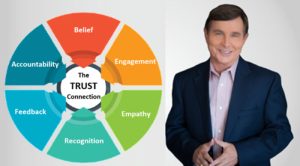
Click here for more information and/or register.
For more information or to register for THE TRUST CONNECTION: How To Build Stronger, Empathic, Engaged Relationships starting May 22, 2025, click here. Take advantage of our BOGO special now.
A recent grad, Rob Meyer, a manager at Blue Cross, says,
“THE TRUST CONNECTION surpassed every other seminar I have ever attended because you gave us detailed action steps and useable strategies. Among lots of other things, I learned exactly how to deliver appropriate recognition and criticism. And it works!”
► 5. Skilled communicator
Highly effective leaders communicate consciously and frequently. They think before they speak to make sure they make the impact they desire, choosing their words carefully, rather than just shooting from the hip. And they communicate with everyone possible in the organization.
The best leaders are also known for the way they listen and the questions they ask. They adhere to the ageless advice that says you should “seek to understand before you seek to be understood.” Leaders stop assuming they understand and start asking a lot more questions to make sure they truly are communicating.
_____ Score yourself from 1 to 10
► 6. Positive thinker
W. Clement Stone, an insurance company founder and prolific writer on positive thinking, taught his sales agents, “The sale is contingent upon the attitude of the salesperson, not the attitude of the prospect.”
In a similar sense, good leaders know that their effectiveness is more closely linked to their own attitude than that of other people. They know that if they are going to motivate others, earn their trust, and get their followership, they must first show how positive they are.
Effective leaders keep a positive attitude. They refuse to give up, and they realize that things are seldom as bad as they might first appear.
_____ Score yourself from 1 to 10
► 7. People developer
Highly effective leaders are always looking for opportunities to develop the potential they see in others. Indeed, effective leaders are more focused on developing talent than they are on acquiring more power for themselves.
Respected leaders do more than just talk about the importance of talent development. They invest time, money, and energy into it making sure it happens.
_____ Score yourself from 1 to 10
► 8. Mistake learner
Effective leaders accept the fact that mistakes are a part of life and work, whether it is their mistake or someone else’s.
More importantly, respected leaders own up to their mistakes, taking responsibility for a bad decision or a poor behavior choice. They don’t try to cover them up or pretend they never happened.
And, effective leaders focus on what was learned by a mistake. Instead of focusing on “who’s to blame,” they focus on “how we will do things differently next time.”
_____ Score yourself from 1 to 10
► 9. Performance rewarder
Effective leaders evaluate people and then place those people in positions based solely on their strengths, performance, and potential rather than seniority or political correctness.
And good leaders consistently reward people for a job well done … because they know unrewarded performance tends to disappear over time.
Leaders also reward problem solvers. They know that a part of their success and the organization’s success is due to the fact that so many other people are out there solving problems. It may be the cheerful employee who treats the customers with respect or the analyst who provides accurate and timely data.
_____ Score yourself from 1 to 10
SCORING
Add up your scores to get a _____ GRAND TOTAL for how well you are doing on the 9 behaviors of highly effective leaders.
INTERPRETATION
80 or above: Excellent. Keep up the good work. You’re on the right path.
60-79: Good. You’re doing alright, but you can and should improve your leadership skills. You’re getting work done and getting a fair amount of engagement from others, but you can achieve so much more. To improve your score, get some feedback, get some coaching, read some books, and take some classes.
36-59: Fair. You are much less effective as a leader than you need to be. You are failing to achieve some of the successes you could be achieving. And you’re probably losing some of the respect and cooperation of those you are trying to lead. Invest time now on your own leadership development.
9-35: Poor. For whatever reason, you are failing to perform some or all of the nine critical behaviors of highly effective leaders. You need to do some serious reflection of whether or not you’re in the right job and/or make a plan to make some serious, significant improvements.
Final Thought: All nine of the behaviors of highly effective leaders are skills that you can learn. Whatever your score is now, you can improve it. Go ahead and do so … now.
|
