

If you know me personally, you know I’m super passionate and intensely curious. I want to live life to the fullest, packing as much as I can into every day. I don’t want to miss anything. So I work hard, really hard and play just as hard.
Now I realize to some of you that sounds awful. You’d much rather sit down with a book and a glass of wine or perhaps a beer and watch a football game on TV.
Others of you may be wondering how you can possibly get everything done. You’re always busy. Your To-Do list is so much longer than you could ever hope to get done. And work-life balance is a concept you’ve heard about but never really understood or mastered.
If that sounds a bit like you, where you’d really love to have more life-work balance, let me assure you that it is not only possible but very attainable. I know. I’ve discovered several strategies that have allowed me to fly four million miles, deliver 4000 presentations around the world, explore 60 countries, and still be blessed with healthy energy, lots of good friends and a caring family.
Maybe one or two of these balance strategies would be worth your consideration as well. After all, you don’t want to be so busy making a living that you lose your life.
► 1. Be honest with yourself.

Start with an honest assessment of yourself. Do you have any signs of stress in your life? Do you worry too much, exercise too little or eat the wrong foods?
If, for example, you have too many aches and pains, your body is trying to get your attention. If your energy is low, your body is trying to tell you that you’re out of balance.
Until you’re honest with yourself and acknowledge your stresses and out-of-balance lifestyle, you’ll rationalize away the need for change. You’ll stay stuck. You won’t do anything about it. After all, if nothing changes, nothing changes.
After Barbara Heiden, a quality assurance chemist at Cargill, attended my Journey-to-the-Extraordinary program, she achieved amazing results when she got honest with herself. She reports.
“It’s been several weeks since I attended your Journey, and I wanted to update you on how things are going. Using your techniques, I am eating well-balanced meals, losing weight, and have more energy than ever! I got a new job that pays a great deal better, and even applied your techniques to our family finances for a net gain of $125,000.00.”
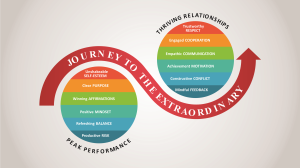
I’ve only got one more virtual Journey this year, October 3-4, 2024. If you want more information or want to register, just click the button.

► 2. Focus on doing the most important things.
There isn’t time for everything, so decide what’s most important and do more of that. Don’t major in the minors.
If you don’t know what’s most important, just ask yourself one question.
If you had six months left to live, would you be living your life the way you’re living it now?
If your answer is “Yes, I wouldn’t change a thing,” I would say you’re living a very balanced life.
On the other hand, if you had just six months to live and your life would change dramatically, that’s a pretty good sign that you are off balance. You’re spending too much time on things that won’t make any difference ten years from now.
► 3. Choose your fights carefully.
Some challenges are not worth your time and energy. Make a conscious choice and an intelligent decision as to when you should fight and when you should pass.
Ask yourself three questions. First, “Does a threat exist?” Is the other person doing something that threatens your success, security, or happiness?
Second, “Is it worth a fight?”
And, third, “If you fight, can you make a difference?”
If you can answer “yes” to all three questions, go ahead. Fight. Talk it out. Find a solution. You have a very good chance of success instead of unnecessary stress. You’re using your energy to bring about the needed change in your life and work.
►4. Balance out your “get” and “be” goals.
Too many people, from individual contributors to executives, only have “get” goals. They want to “get” ahead, “get” that promotion, “get” that new boat, “get” that trip, and “get” a million other things.
That’s not all bad. I’m always teaching people about the importance of having goals and then teaching them a foolproof way to achieve those goals in my Journey-to-the-Extraordinary program.
You can join my next Journey program on October 3-4, 2024 by clicking here
While it’s important to have “get” goals, you also need “be” goals. What do you want to “be?” Who do you want to “become?” Maybe you want to “be” happier, more content, and more confident. Maybe you want to “become” a more effective leader. You see, ten years from now you will be a different person than are you today. Are you planning for it? Are you setting “be” goals? Or are you just winging it, hoping things will turn out alright?
I hope to God you are one of those smart people who are setting both “get” and “be” goals. There’s so much more to life than “getting” things. The true joy comes in the “getting” AND the “being.”
Be one of the fortunate few who know how to make a living and a life.
►5. Learn that life is unfinished.
Like me, you were probably raised to get all your work done before you could play. That’s not a bad thing to teach children. They have to learn about time management.
The trouble is most of you reading my Tuesday Tips are working people, professionals, and caring for others. If you took that advice literally … to get ALL your work done before you play … you would never find time to play. As you well know, there’s always going to be more work than time.
To maintain your balance, force yourself to take breaks – even if all your work isn’t finished. Escape for a while. Make some time to just read or think. Lose yourself in a movie or game. Take a brief trip for a change of scenery. You’ll go back to your work with more energy than you thought possible.
►6. Increase your appreciation.
Practice an attitude of gratitude. Quite simply, stress cannot exist in an atmosphere of thankfulness. So focus more on what you have and be grateful for that and spend less time thinking about what you don’t have.
That won’t be easy. Pop culture and advertising campaigns have made us think that we should be constantly striving for more, bigger, and better. Unfortunately, that can lead to a lot of stress, discontent, and imbalance.
A simple strategy changed my life and will work for you as well. I took a walk outside, by myself, and started saying out loud, with meaning and enthusiasm, 1000 times, the words, “Thank you, thank you, thank you …” After that exercise, whenever something stressful enters my life, a thought of thankfulness pops into mind and weakens the stress.
Final thought: No one on his deathbed ever wished he had spent more time at the office. But lots of people get to their deathbeds wishing they had lived a more balanced life.