
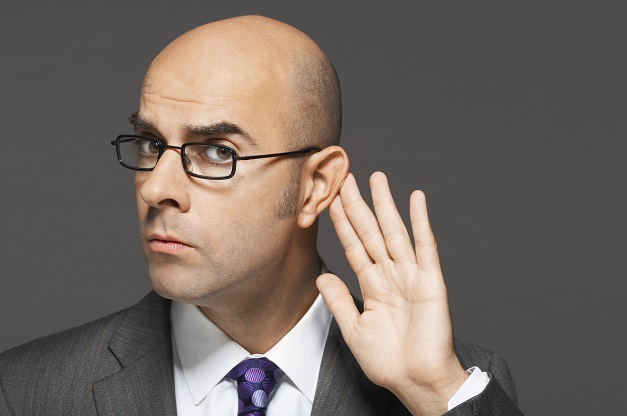
Who cares if you’re a lousy listener?
If you’re a leader, your coworkers care a lot about your listening or lack of it. One study asked several thousand workers to identify the most serious faults observed in executives. The most frequently cited response, mentioned by 68% of the respondents, was the failure of the boss to listen, to see the other person’s point of view.
Do you think those leaders pay a price for their bad listening? Absolutely. In those kinds of work environments, engagement, morale, and productivity take a nose dive.
Who else cares if you’re a lousy listener?
Your friends and family members also care a lot. If you observe a couple while dating, you will often be struck by their excellent listening skills and how tuned in they are to each other. However, that same couple, five or ten years later, may have lost their ability to listen or their willingness to listen. They let their minds wander when the other person is talking, glance at their watches, check their text messages, or think about what they’re going to say instead of listening to what is being said.
Do you think the people in those relationships pay a price for their bad listening? ABSOLUTELY! That’s why a “breakdown in communication” is cited as one of the most frequent causes of divorce.
I know I paid a huge price for being a lousy listener years ago. There were dozens of times my young daughter would say to me, “Dad, Dad. I want to tell you something.” And all too often I’d say, “Not now… I’m busy … Later …” until the day came when she stopped trying to get my attention. We hardly spoke to each other for the next several years, a tragic mistake that I will always regret.
So if you are anything less than an excellent listener, let me suggest that you start improving by doing these things.
► 1. Be willing to listen.
In my Journey-to-the-Extraordinary program, I’ll ask the participants, “How many of you can turn up your listening effectiveness by simply deciding to listen really well?”

One hundred percent of the hands go up. That tells me that your listening effectiveness can be traced to both your willingness to listen and your ability to listen.
To improve your listening, whenever you enter a conversation, personal or professional, make a conscious decision that you’re going to listen well.
► 2. Remove physical barriers and distractions, if possible.
Physical barriers create distance and discomfort. A desk communicates a superior-inferior message. One researcher found that only 11% of patients are at ease when the doctor sits behind a desk, but 55% of the patients are at ease when the desk is removed.
It’s also very difficult to listen well if there several distractions calling for your attention. It may be that the TV is on when you’re talking to someone, or your phone beeps with each incoming text message, or whatever. If the other person is important enough to you, if what they say is important for you to understand and get it right, remove or turn off as many distractions as possible.
Ty Inglis, a CPA at Eide Bailly LLP, learned to do that and so much more at my Journey-to-the-Extraordinary experience. Ty says,
“Before the Journey, I would often continue to work or be distracted when staff members came into my office. This approach left people with the impression that I was not interested in them or their concerns. After I attended your Journey program and learned the amazing techniques you taught us, I have made a concerted effort to employ the listening techniques that we learned. This has made me a better listener and has dramatically improved my relations with my staff.”
I have only one more public offering of the Journey-to-the-Extraordinary program left in 2024. It will be virtual, October 3-4, from 9 am to 6 pm Eastern Time. And if you register by tomorrow, you save 40% on your tuition. Register now.

► 3. Lean forward.
The more you physically position yourself to listen, the more you will listen. Your posture indicates your degree of involvement in the conversation. If you lean backwards, maybe even putting your hands behind your head, you’re saying, “I’d rather take it easy than work too hard at listening to you.”
By contrast, leaning forward says, “I am ready to listen. I really want to hear what you have to say. Go ahead.” And this technique applies to both face-to-face as well as virtual conversations.
► 4. Look at the speaker.
If you doubt the importance of eye contact, think of a person that does not look at you when they speak. How do you feel when that happens? Not very good. You’ll probably wonder why the other person isn’t paying attention or wonder what they’re thinking. You’ll wonder if the other person even cares or can be trusted.
Simply put, there’s no substitute for eye contact to improve your listening effectiveness.
Now I know that’s more challenging these days when more and more of our conversations are virtual rather than in person. But you’ll take a big step forward even in those calls if you keep your camera on and look at the screen. As we all know, when a person is on a virtual call and someone’s camera is turned off, they’re probably doing something else instead of just plain listening.
► 5. Refrain from restless body movements.
Tapping your fingers or jiggling a foot is fine if you’re listening to music, but not to people. If you’re moving around or showing restless body movements, that’s a pretty good sign that you’re not totally tuned in. You’re thinking of your own emotions or something else in life.
If necessary, force yourself to relax. Stop distracting and disrespecting hand, foot, and body movements. It will smooth the way to a much richer conversation.
Final Thought: At the heart of every good marriage, every positive working relationship, every successful sale, every productive team, and every act of true customer service is listening. Listening is too important to be left to chance, and listening can be learned. What are you doing to become a better listener?